A buyer walks into escrow on a Warner Center condo with an FHA pre-approval letter in hand, a decent credit score, and a lender who has already run the numbers twice. Then the lender's underwriter asks for the project approval documentation, and the deal stalls. Not because of the buyer's income or credit. Because the building itself was never cleared for FHA financing. Two condos a few blocks apart, similar age, similar price, and their FHA approval status can affect whether that buyer's loan works.
For buyers shopping Warner Center condos, checking each project's current FHA status can clarify which financing options are available.
The building that suddenly said yes
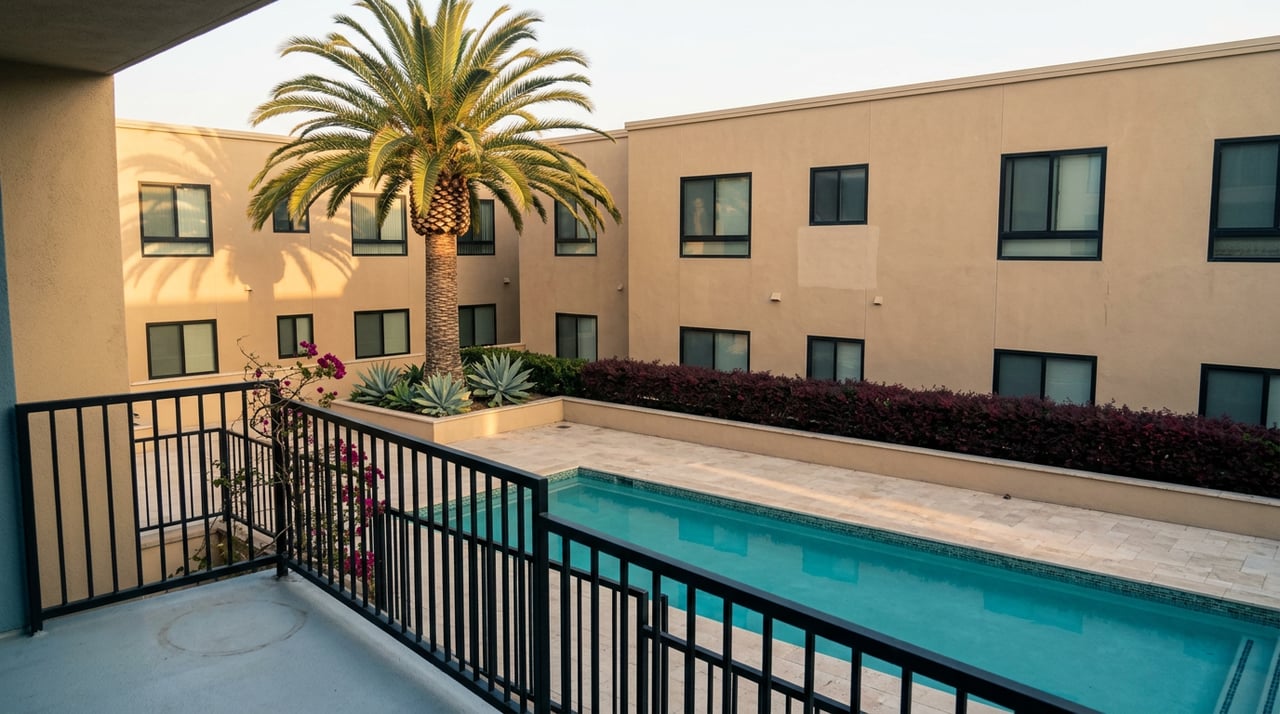
The Met at Warner Center sits at 5515-5555 Canoga Avenue, a gated complex of roughly 1,279 units spread across 16 buildings. It was built as condominiums in 1987, but high interest rates at the time pushed the developer to lease the units as apartments instead. Around 2004, the property was converted back to condos and given a resort-style renovation, the pools and landscaping and clubhouse amenities that show up in every listing photo today.
For years, The Met carried VA approval, which let veterans buy in with zero down. FHA approval is a separate certification, reviewed against a different set of standards, and The Met did not have it. That changed on December 2, 2025, when the complex was officially added to the FHA-approved project list. The HOA announced it as good news for property values and for the pool of buyers who could now qualify, and it was right to frame it that way. FHA approval does not just add one more financing option. It reopens the door to the segment of buyers most likely to need it.
Six months before that approval came through, The Met's HOA had already replaced its master insurance policy through Venbrook Insurance, effective June 1, 2025, raising property coverage from $10 million to $500 million. Adequate master insurance is one of the items FHA reviewers look at closely before certifying a project. The timing is not proof of cause and effect, but the sequence lines up with how these approvals typically get unstuck: fix the insurance gap, then clear the financing hurdle.
What the certification actually buys a seller
FHA loans are disproportionately a first-time buyer product. That matters for a 1,279-unit complex because first-time buyers are exactly the demographic priced out of most single-family inventory in Woodland Hills, where homes have traded at a median around $1.2 million over recent months according to Redfin's tracking through May 2026. A condo in the high $300,000s to mid $500,000s is the realistic entry point for that buyer, and FHA financing is often the only way they get there with a manageable down payment.
The Met's own 2025 sales figures show what that buyer pool looks like in practice. The complex recorded 42 sales that year: 14 one-bedroom units averaging $370,993, and 28 two-bedroom units averaging $500,961. No three-bedroom units sold. That is a building moving almost entirely in the price band where FHA borrowers shop, which makes the newly widened financing eligibility less a footnote and more a direct explanation for why the complex keeps finding buyers.
Zoom out to the broader condo market and the contrast sharpens. Woodland Hills condo sales ran a median price around $519,000 in June 2026, based on local MLS data, well under half the citywide single-family median. Warner Center itself currently shows about 34 active condo listings with a median asking price near $510,000, and Redfin data shows those listings averaging 56 days on market with roughly one offer each. That is a buyer's market on paper. But paper doesn't tell you which specific buildings that pace applies to, and it doesn't tell you which ones just quietly expanded their qualified buyer pool.
Two Warner Center complexes, two different answers
Not every condo community near The Met carries the same certification, and that is easy to miss because the units themselves can look nearly interchangeable in a listing photo.
| The Met at Warner Center | Warner West | |
|---|---|---|
| Address | 5515-5555 Canoga Ave | 22100 Burbank Blvd |
| Year built | 1987 (condos), renovated ~2004 | 1979 |
| Units | Approximately 1,279 across 16 buildings | 195 |
| FHA approval | Approved December 2, 2025 | Not confirmed in current public records |
| Recent pricing signal | 2025 sales averaged $370,993 (1BR) and $500,961 (2BR) | A unit at 22100 Burbank Blvd, #230C, recently sold for $469,995 |
Warner West is a three-story complex a short distance away, built in 1979, with a similar unit mix and a similar price range. Nothing in publicly available records confirms current FHA project approval status for that community. That does not mean the building is a poor choice. It means a buyer who assumes FHA financing works the same way across every Warner Center condo complex is making an assumption the building itself has not agreed to.
This is the part that rarely makes it into a listing description. A condo's square footage, HOA dues, and amenities get top billing. Whether the project is on HUD's approved list, and whether that approval is current rather than expired, sits several steps down in due diligence, usually surfacing only after a buyer is already emotionally attached to a unit and financially committed to an escrow deposit.
What this means before you write an offer
If you are financing a Warner Center condo purchase with an FHA or VA loan, the building's certification status is not a formality to check after you fall in love with a unit. It is a filter to run before you tour it.
A few things worth confirming early:
- Whether the specific complex is currently on HUD's list of FHA-approved condominium projects, not just whether it was approved at some point in the past. Approvals can lapse and need renewal.
- Whether VA approval and FHA approval are treated as the same thing by the listing agent or HOA. They are separate certifications with separate review standards, and a complex can hold one without the other, as The Met did for years.
- The HOA's reserve fund percentage and the age and coverage limits of its master insurance policy. These are the underlying financial health indicators that determine whether a project clears FHA review in the first place, and they matter for conventional financing too.
- Whether recent capital improvements, like the kind of insurance policy overhaul The Met completed in mid-2025, have been documented and submitted as part of any pending or recent approval application.
None of this shows up in a standard listing sheet. It shows up in HOA board minutes, insurance certificates, and a phone call to the property management company, which is exactly the kind of paperwork chase that determines whether a deal closes on schedule or falls apart three weeks into escrow.
A few questions worth asking
Does VA approval mean a building is also FHA approved? No. They are reviewed under different programs with different requirements. A complex like The Met can carry VA approval for years, as it did, while FHA approval lags behind or is absent entirely.
How can I check a specific complex's current FHA status myself? HUD maintains a public database of approved condominium projects that any buyer or agent can search directly. Status can change, so confirm it close to the date you plan to make an offer rather than relying on an older listing note.
What happens if I'm already in escrow and my lender discovers the project isn't approved? The loan typically cannot close as structured. Some buyers switch to a conventional loan if they qualify, others negotiate a longer closing timeline while the HOA pursues approval, and some walk away. This is why confirming status before writing the offer, not after, protects everyone's timeline.
Financing eligibility at the building level is one of those details that never shows up on a spec sheet but decides who can actually buy, how fast a unit moves, and what negotiating leverage looks like on both sides of the table. If you are weighing a Warner Center condo purchase or trying to price one for sale, Cindi Brodack can help you check the paperwork that actually determines your buyer pool before you are three weeks into an escrow that was never going to close.
This article is general information, not legal, tax or financial advice. Consult a qualified professional about your situation.